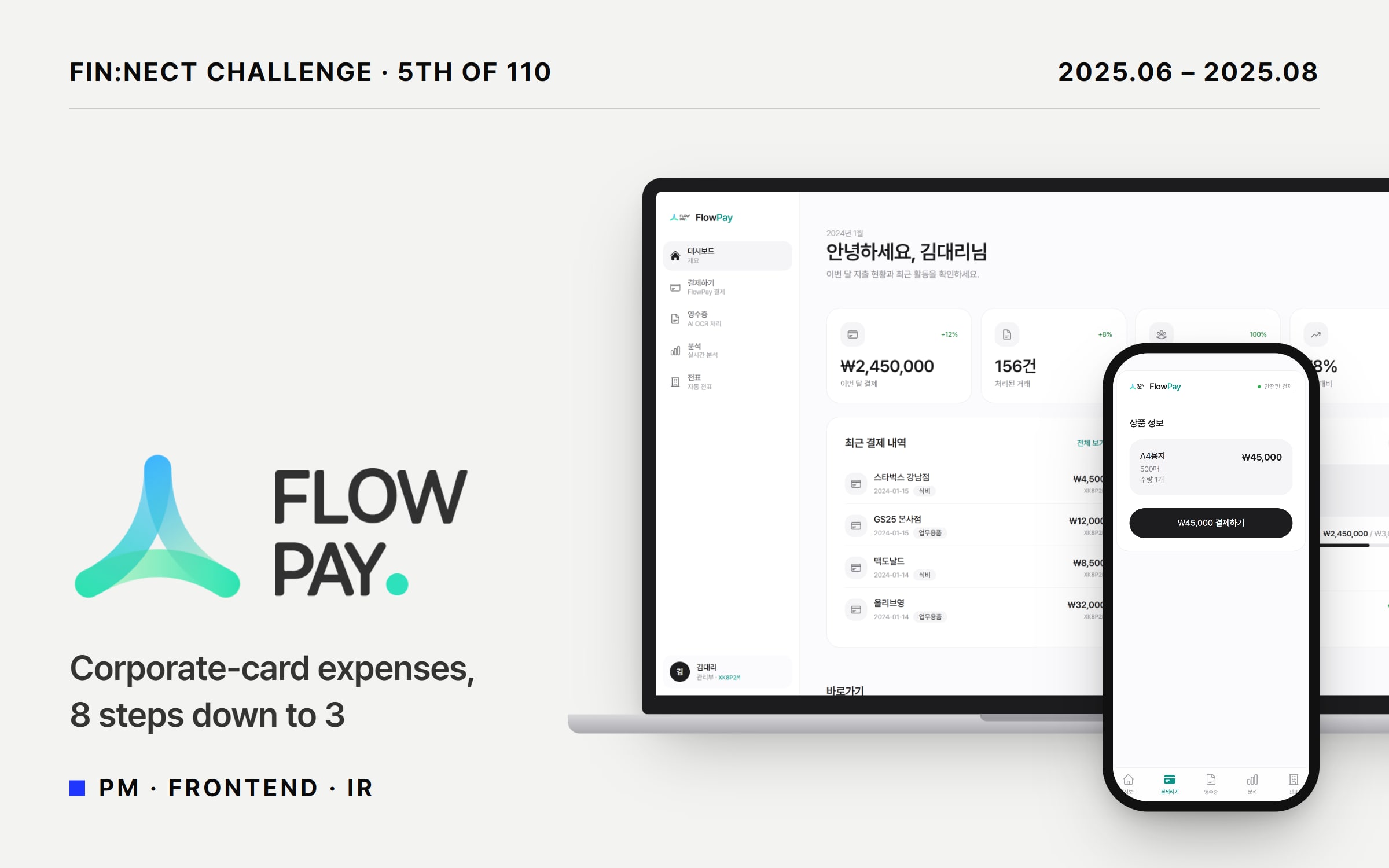
I cut anonymous corporate card reconciliation from 8 steps to 3.
A B2B prototype that automates anonymous corporate-card spending from payment to expense report
- Period
- Jun – Aug 2025
- Role
- PM · Frontend · IR
- Status
- Award · 5th of 110
Summary
Accountants were spending 20 minutes per expense report, over 100 reports a month. Interviews showed the real bottleneck was the vouchers written by hand after each payment, so I designed Flow ID, a pseudonymous token that identifies the user at the moment of payment while keeping anonymity, so expense reports generate themselves. It placed 5th of 110 teams at the FIN:NECT Challenge.
Impact
- corporate-card reconciliation steps
- 8 stepsto3 steps
- expense report writing
- 20 min eachtoAutomatic
- FIN:NECT Challenge, Encouragement Prize
- 5th of 110
Background
- Employees spend 20 min per expense report; accountants process 100+ per month — resulting in ~1,000 hours and ₩80M in annual labor costs per company. As of 2025, only 3 card issuers support easy payment for anonymous corporate cards.
- Interviews with accountants confirmed the biggest pain point: triple repetitive work of 'collect receipts → manually write expense report → enter accounting voucher.'
- A FINNECT Challenge (fintech hackathon) project — in a 3-person team, I handled PM, frontend development, and the IR pitch. (Jun–Aug 2025)
Execution
PM & Product Planning
- Conceived the Flow ID-based anonymous tagging system: auto-identify and log anonymous card users, shortening the workflow from 8 steps to 3.
- Mapped user journeys, designed IA, established sprint plans for the 3-person team, and chaired weekly meetings.
Frontend Development
- Built real-time dashboard (department budget status, AI anomaly transaction detection) and data visualization components in React.
- Integrated FIDO2 API to develop a 1-second biometric payment system (fingerprint/Face ID), eliminating complex authentication while maintaining security.
Business Strategy & IR Pitching
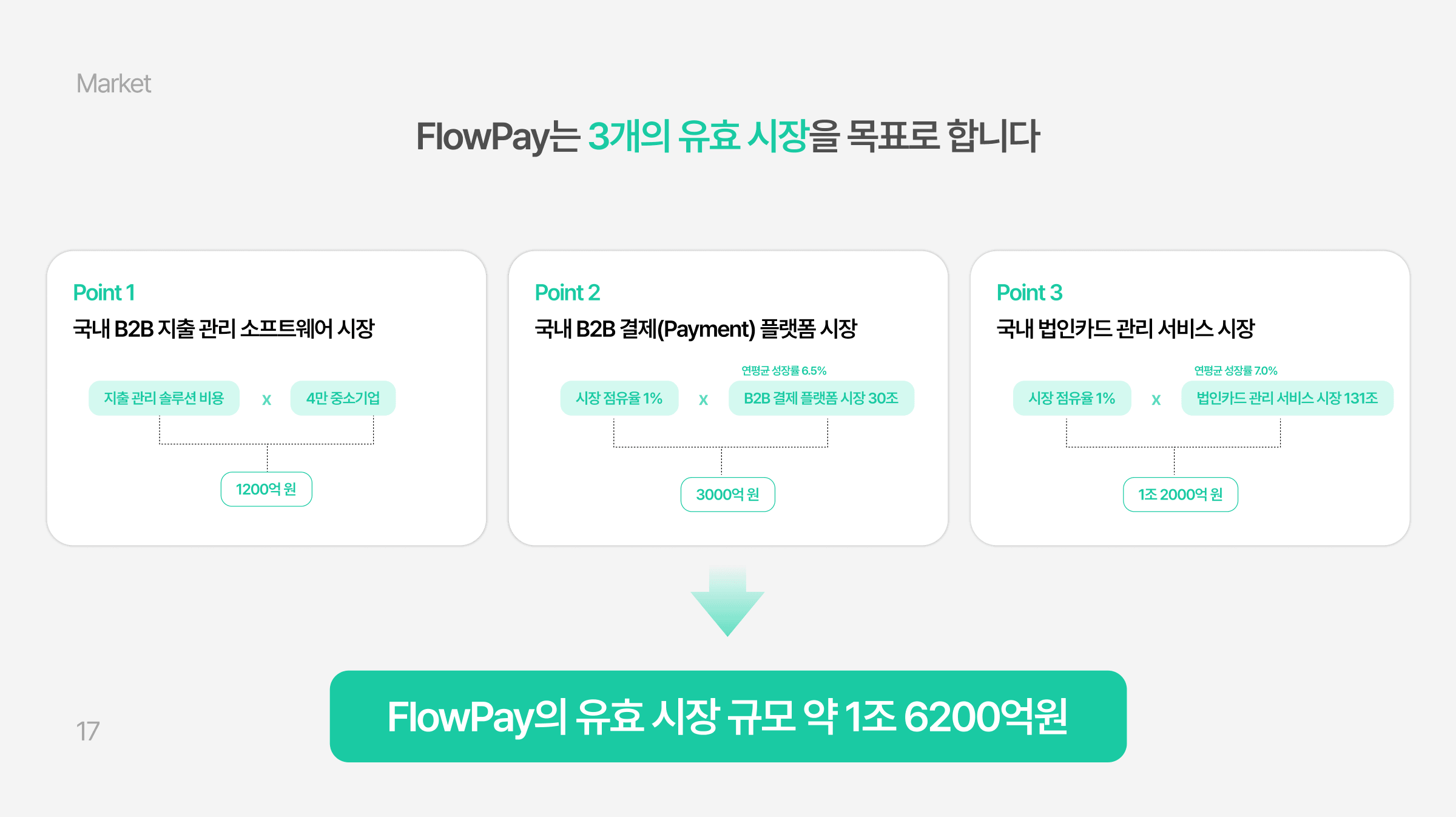
- Analyzed TAM/SAM/SOM across 3 addressable markets, sizing the total at ₩1.62T. Built a phased roadmap: Phase 1 (50 companies) → Phase 2 (800) → Phase 3 (Enterprise/IPO).
- Personally delivered the FINNECT Challenge IR pitch, winning 5th place (Encouragement Prize) out of 110 teams.
Results
- Won Encouragement Prize at FINNECT Challenge (5th of 110 teams) — redefining the problem through interviews and cutting reconciliation from 8 steps to 3 led to this outcome.
- Serving as PM, frontend developer, and IR presenter in a 3-person team, I experienced the full B2B SaaS planning cycle: problem definition → solution design → implementation → commercialization strategy.
What I learned
- Interviews with working accountants showed the biggest cost sits in the vouchers written by hand after each payment. Identifying the user at the moment of payment removes the voucher entirely, so I moved the design's starting point from the payment screen to the payment data, and that decision took reconciliation from 8 steps to 3.
- The part judges asked about most was the revenue model that combines an enterprise subscription with transaction fees. That is when I decided that in B2B, showing how money actually moves comes before technical novelty.