Smart Expense Manager
RZi
- Period
- Jul 2025 – Aug 2025
- Role
- PM · Full-stack


Background
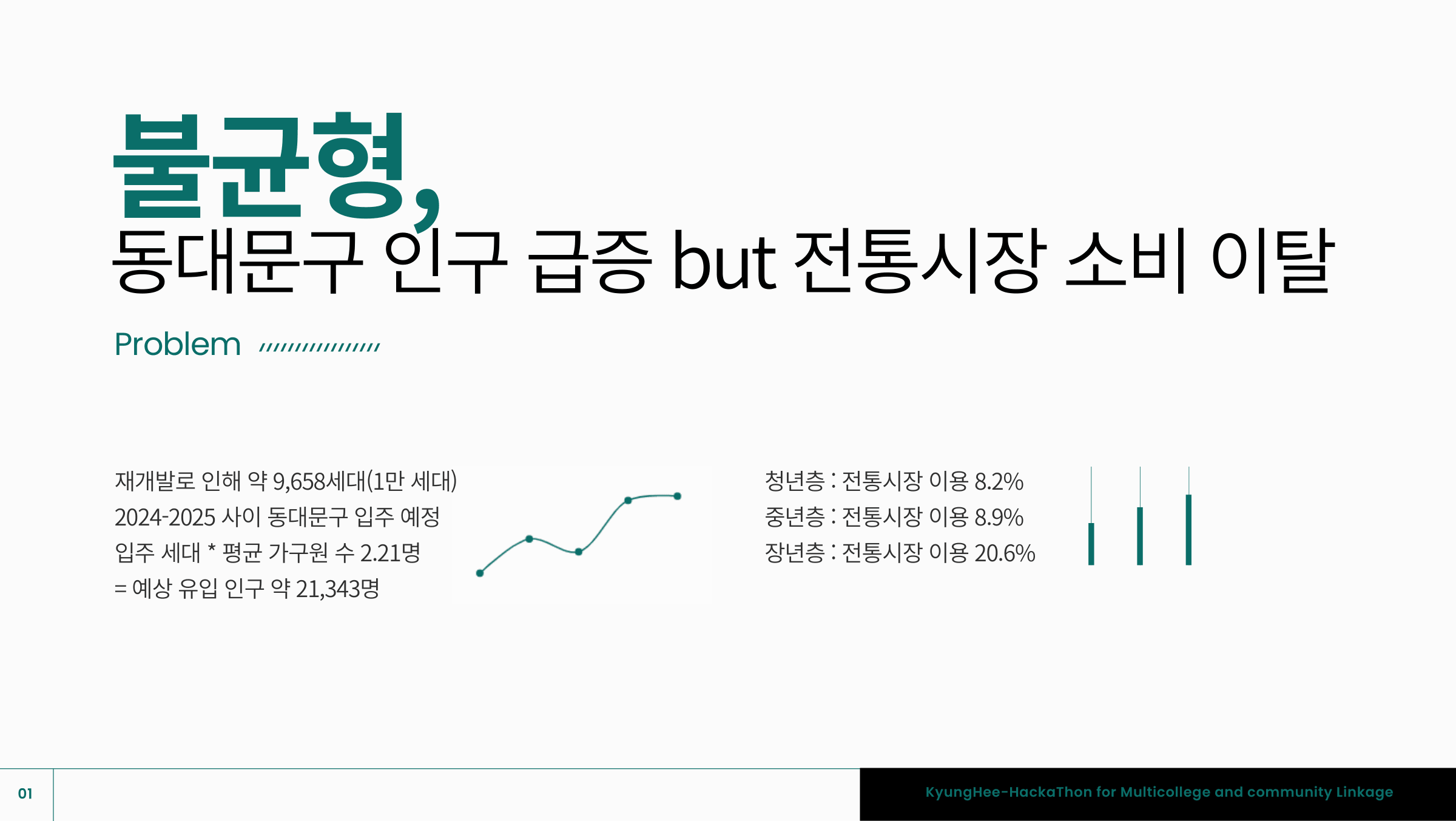
- Initiated as a challenge for the K-HTML Hackathon (co-hosted by Seoul Dongdaemun-gu and KHU). Data confirmed that while 21,343 new residents are expected to move into Dongdaemun-gu, traditional market usage among youth stands at just 8.2%.
- Analyzed 6 major pain points of traditional markets: price opacity, complex layout, cash-only payment, no inventory info, unsearchable online, poor parking. Identified 'price opacity' and 'product discovery difficulty' as the core entry barriers.
- Established a 3-phase expansion strategy: B2C individual users → B2G local government partnership. Conceived a model to accumulate data through merchant association partnerships and provide local economic revitalization insights to local governments.
Execution
Planning & Product Design
- Planned the complete service flow of a comprehensive shopping assistant PWA combining OCR technology and AI recommendations.
- Defined 4 core features: real-time price comparison (traditional market vs. large mart), OCR receipt scanning, Google Maps-integrated navigation, and AI alternative product recommendations.
Architecture Design & Development Lead
- Designed a Next.js 15 + React 19-based PWA architecture and implemented core PWA features: offline support, home screen installation, and fast loading.
- Served as project lead covering the entire team — from planning and development to design and team management.
Results
- Completed K-HTML Hackathon (Jul 16 – Aug 30, 2025) and delivered a practical community service integrating OCR, AI, and Google Maps.
What I learned
- I drew the behavior flow first — compare price, explore, buy — and kept only the features that flow needed. OCR and AI were placed as the means to make that flow smooth.
- The district office, merchants, and consumers all wanted different things. No single feature satisfied all three, so we sequenced it: a three-stage expansion from B2C to B2G.