Anesthesia Guidance System
NeuroSight
- Period
- Jul 2025
- Role
- PM · IR
Background
- Anesthesia is a high-risk procedure where incidents directly threaten lives — and a large share of incidents occur in settings without anesthesia specialists. A chronic shortage and high turnover of anesthesiologists is the structural root cause.
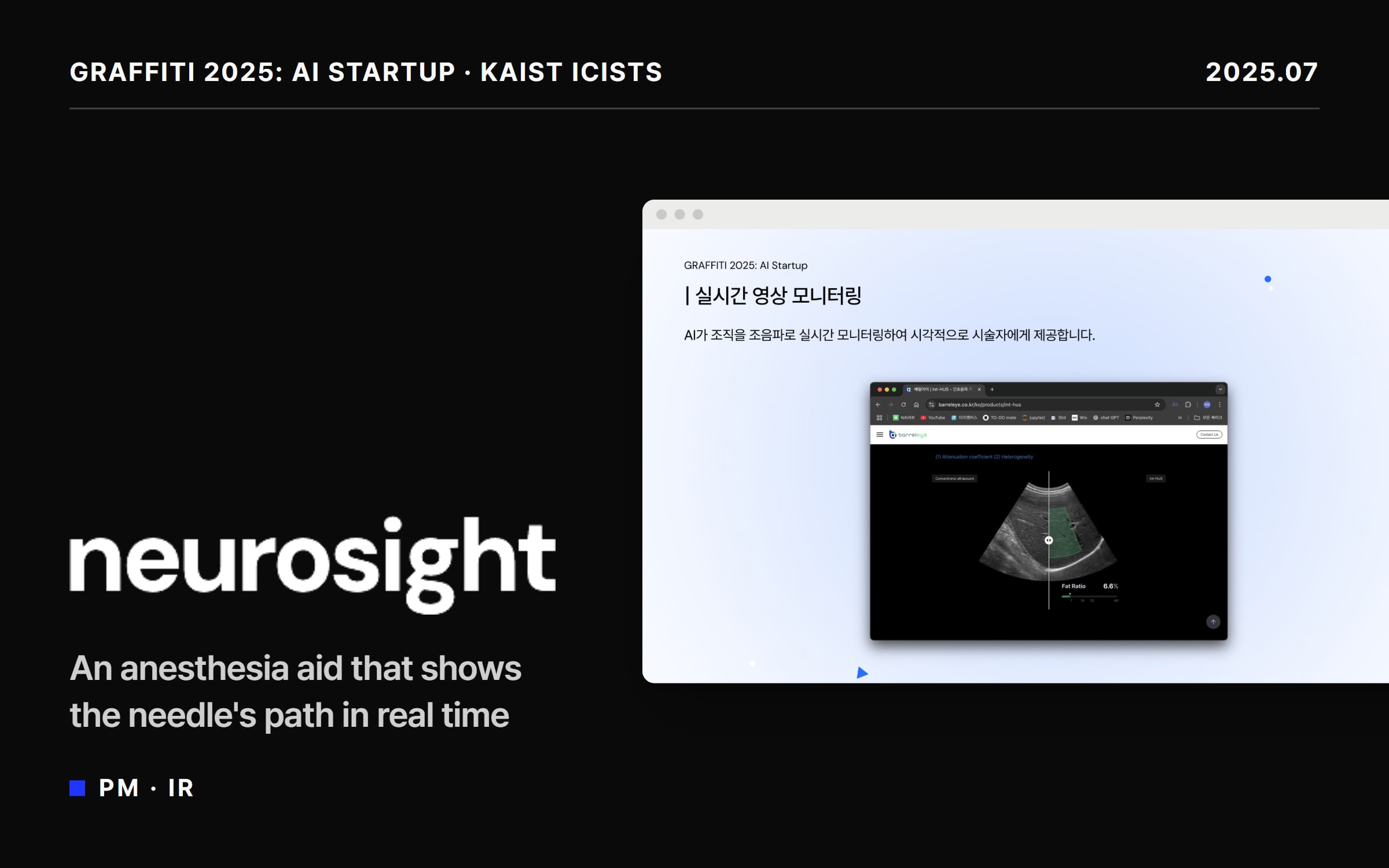
- Existing B-mode ultrasound relies on subjective interpretation, with no quantitative tissue analysis or real-time anesthetic diffusion tracking.
- GRAFFITI 2025: AI Startup (hosted by KAIST ICISTS) hackathon — served as business idea planner in a 6-person team over 4 days. Designed the concept of applying Barrel Eye's QUS technology to anesthesia.
Execution
Market Research & Problem Analysis
- Analyzed anesthesia incident trends and the structural over-reliance on non-specialists. Researched the growth of the global medical AI market and identified entry opportunities.
- Researched Barrel Eye's QUS technology trends and evaluated applicability to anesthesia, establishing positioning as the world's first QUS-based anesthesia guidance system.
Business Model Design
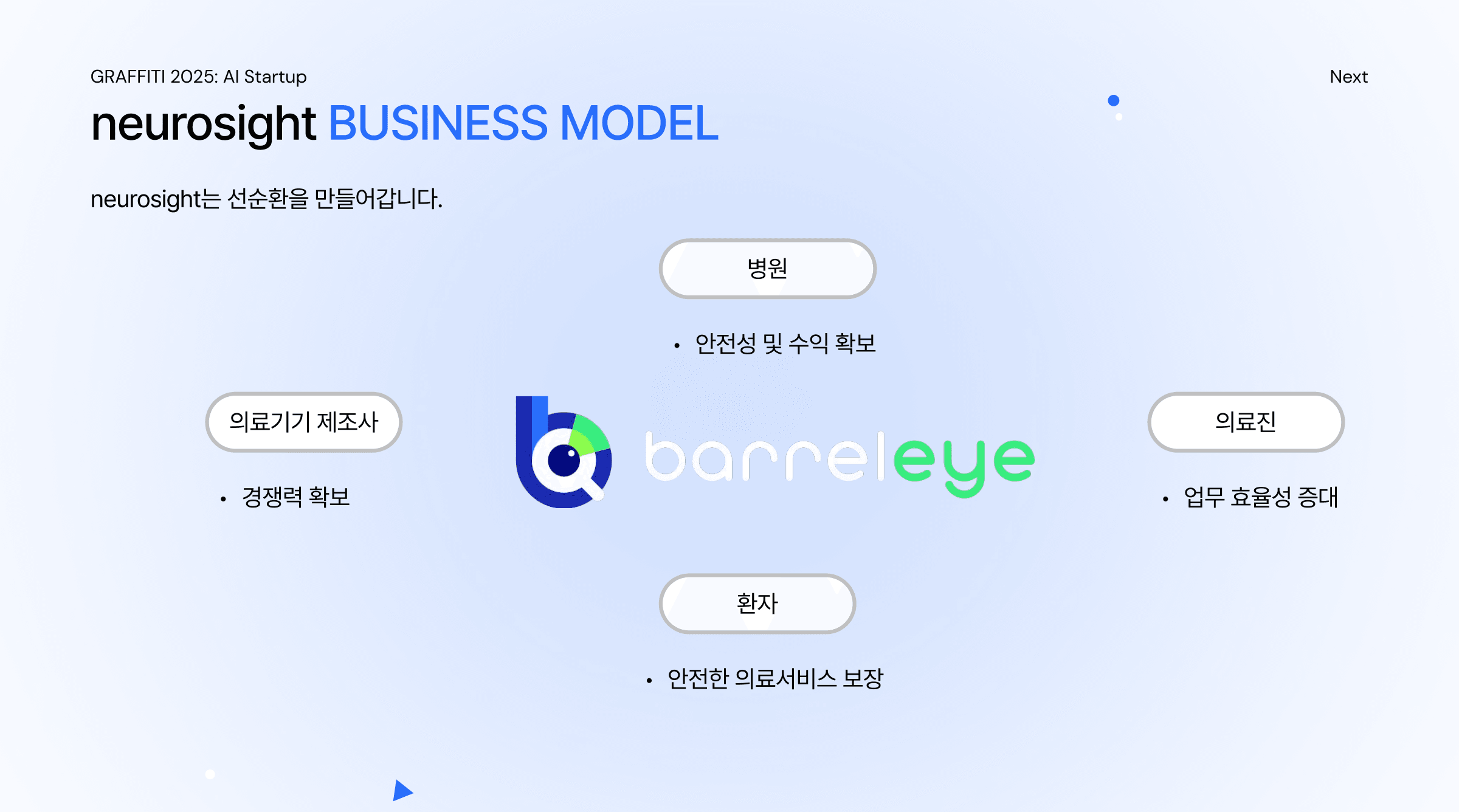
- Designed a hybrid revenue model: B2B SaaS (hospital subscriptions) + OEM partnership (technology licensing to medical device manufacturers such as GE, Philips, and Siemens).
- Established a market entry strategy that distributes FDA/CE regulatory risk through OEM partnerships. Phase 1 (3% North American market share) → Phase 2 (global OEM expansion) → Phase 3 (Asia/Europe).
Solution Concept Design & Pitching
- Researched CNN + PINN + Transformer multimodal AI architecture use cases, defined medical personnel persona and user scenarios. Created pitch deck and personally delivered the idea pitch.
Results
- In 4 days, learned medical AI technology, regulation, and market dynamics, and proposed an OEM hybrid commercialization strategy that turned FDA/CE regulation into a revenue source. (GRAFFITI 2025 AI Startup, hosted by KAIST ICISTS)
What I learned
- Four days isn't enough to understand medical AI tech. So we started from the problem — who gets hurt, when, and why — and placed the technology (QUS) around that answer. A sharp problem carries a plan even when tech depth is shallow.
- The response changed when we flipped FDA/CE regulation from a risk item into an OEM revenue source. Regulation isn't something to dodge — it's something to design in.