Terms-of-Service Risk Alerts
TCP
- Period
- Apr 2025 – May 2025
- Role
- PM
Background
- A survey of 131 people revealed that 93% don't read terms of service properly. The SKT SIM hacking incident brought consumer damage from unread ToS to the forefront as a social issue.
- Confirmed that no automated real-time ToS analysis service exists in Korea yet — and started by verifying why that gap exists.
- Existing review services required users to manually copy-paste text, with no tools to understand complex legal language. Concluded that background auto-detection and analysis would be the key differentiator.
Execution
Product Planning & Business Model Design
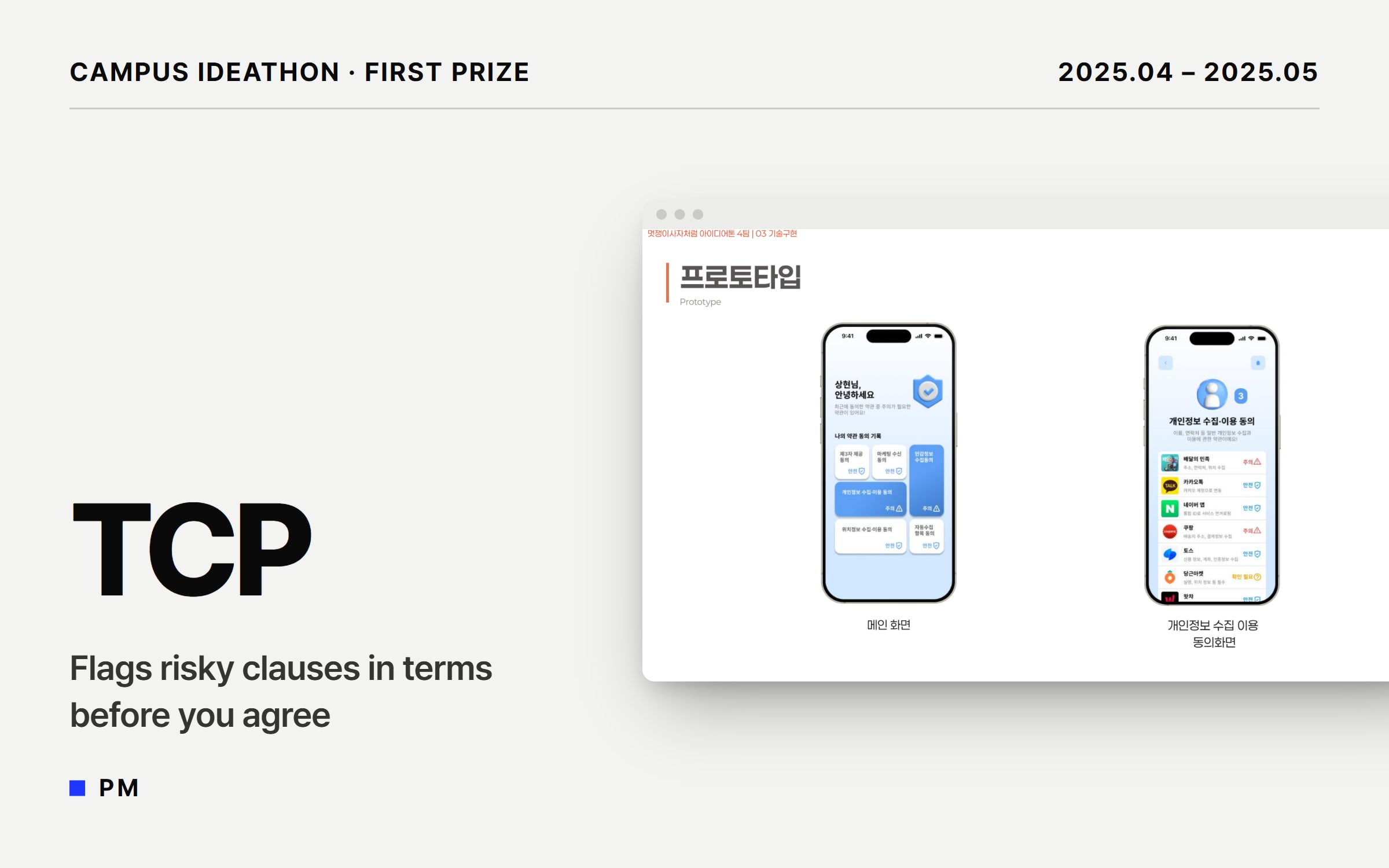
- Planned a system that automatically detects and analyzes ToS content in the background at the moment of user agreement, using screen overlay technology.
- Designed the technical direction: fine-tuning BERT/GPT-based NLP models on legal-domain datasets to auto-extract key clauses and risk factors.
- Planned UX to summarize complex ToS in plain language and visually highlight risky clauses with highlights and warning icons.
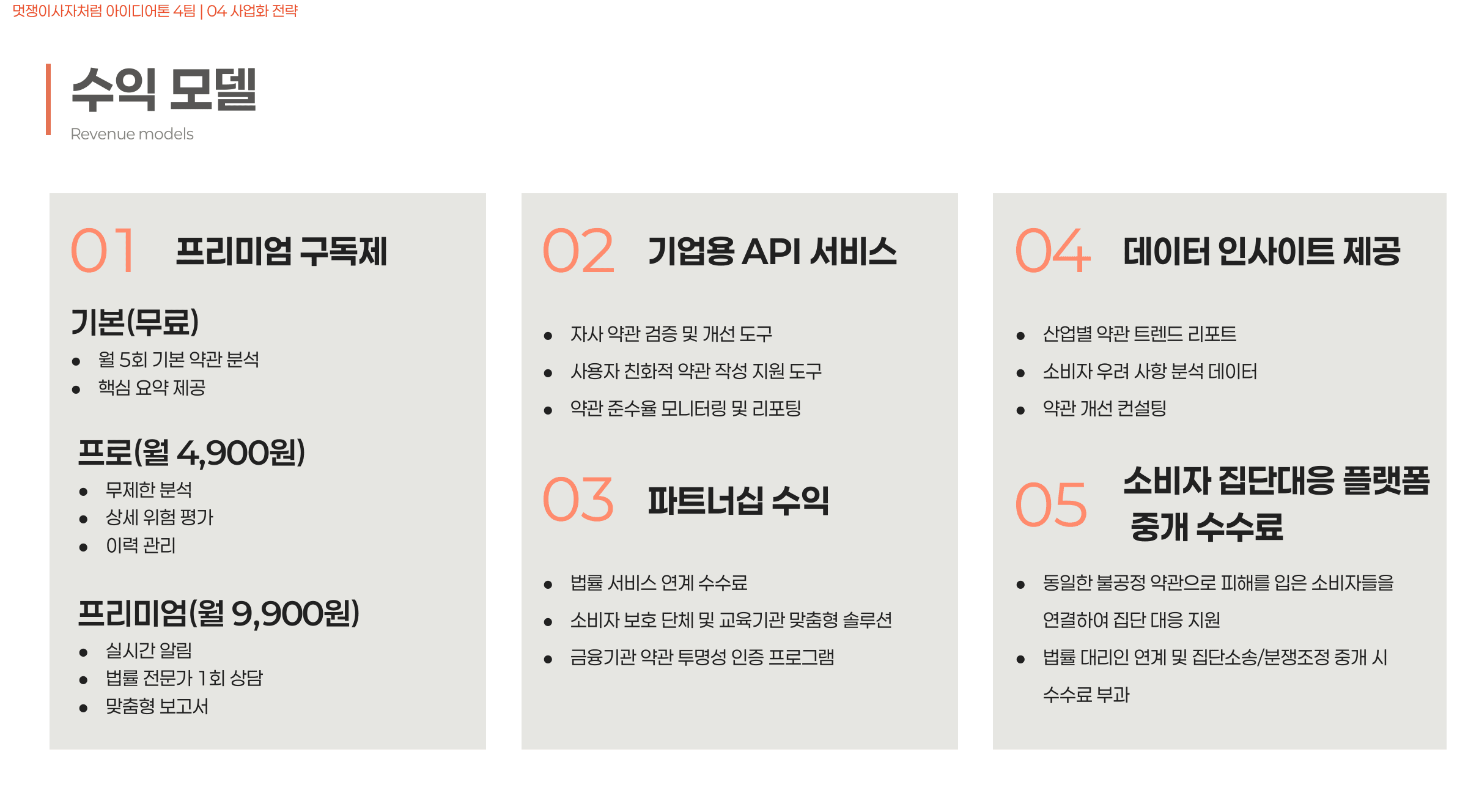
- Structured 5 revenue streams: premium subscription (B2C), enterprise API (B2B), law firm & fintech partnerships, anonymized data insight sales, and collective action brokerage.
Market Research & Competitive Analysis
- Benchmarked domestic and overseas legaltech services (DoNotPay, Ironclad, etc.) to establish the differentiation of background auto-detection.
- Defined primary target as '20s–40s who frequently subscribe to digital services,' with financial and subscription platform companies as key B2B partners in the expansion phase.
Results
- Won campus Ideathon Grand Prize — our own 131-person survey data (93%) proved both the severity of the problem and the business case.
- Advanced to 2nd round of national hackathon — technical feasibility (BERT/GPT fine-tuning, screen overlay) and specificity of the revenue model received high marks from judges.
What I learned
- We built the pitch on one figure from our 131-person survey: '93% don't read the terms.' I judged that survey data shows the size of a problem to judges more clearly than any claim.
- Digging into 'why doesn't this exist yet?' taught us more. There were reasons (legal-interpretation risk, access to terms text) — and only after rebutting each one could we call it a blue ocean.